 Coming soon
Almost ready.
The Arta Card case study is getting its final polish before launch. Check back soon.
Browse the other case studies
Coming soon
The Arta Card case study is getting its final polish before launch. Check back soon.
A fintech design exercise for Arta Finance: launch a portfolio-secured charge card inside a wealth platform. I answered with a working product — two live flows, a coded design system, and a white-label model — built with AI in one week.
00 Overview
The exercise asked for three things: a card application, an AI relationship across the lifecycle, and a partner-brand model. The real question underneath: can lending live inside a wealth relationship without breaking trust? I answered with working software, not a deck.
Design the application, define the AI relationship, extend both to partner brands — for a portfolio-secured charge card, not a bank credit card.
Two interactive flows, a coded design system, a Storybook, a white-label demo, and a narrated presentation — all real, all explorable at /arta.
I framed the positioning and trust economics, then built every surface with AI as my pair. The judgment stayed human; the production speed didn't.
01 Context
Arta's first lending product lands on a platform built for growing wealth. Today Arta asks "what do you want to grow?" — a card application asks "let us judge you." The strategic problem: keep the premium trust posture through a flow that is legally required to interrogate, disclose, and sometimes decline.
An application experience plus an AI relationship across the card lifecycle, with a model that extends to partner brands.
For existing members. Eligible custodied assets and the Arta relationship inform prequalification and the recommended limit. Balances never revolve.
Use member and portfolio context to reduce effort, personalise the offer, and support better decisions over time — the family-office pattern, productized.
The Design Question
How might we use Arta's existing member and portfolio relationship to make applying for — and managing — a charge card feel effortless, while keeping members informed and in control?
Verified member and portfolio data reduces effort and personalises the offer. → Flow 1, the application.
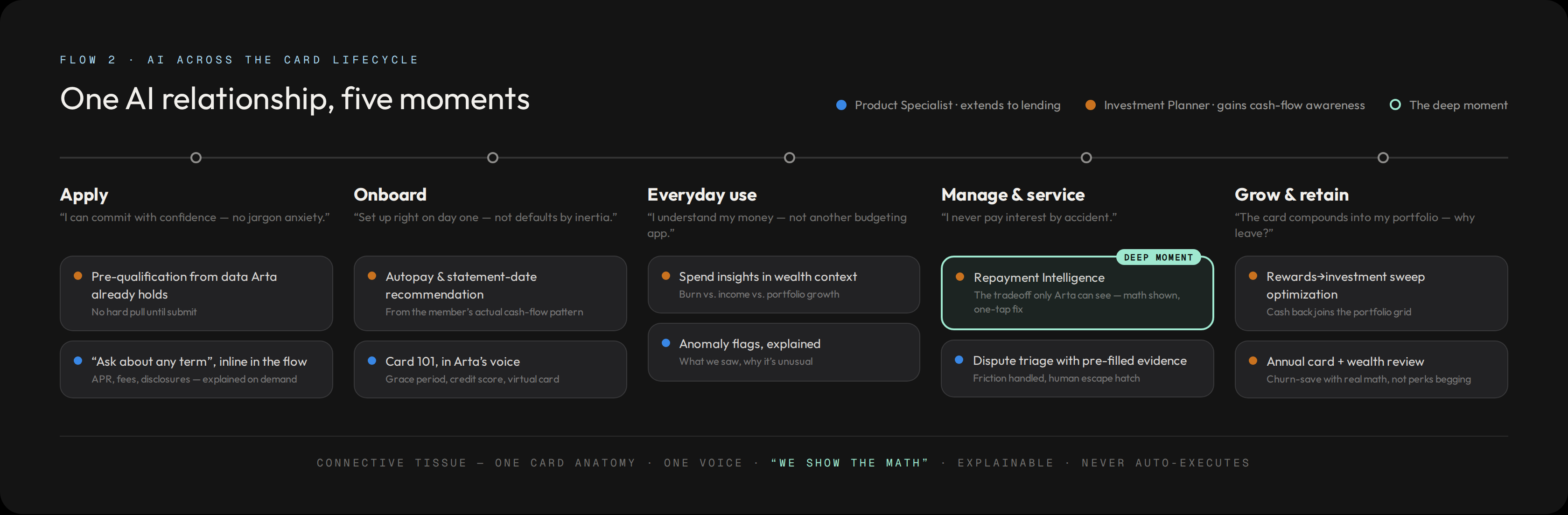
Explain important decisions, recommend responsible actions, keep members in control. → Flow 2, the AI lifecycle.
Partners express their brand while Arta's standards for decisioning, compliance, and AI safety hold. → The white-label model.
02 Clarify Problems
Depth beats coverage in a time-boxed exercise: one core member carries the design, one edge case stress-tests it, and every assumption — market, audience, positioning — is declared before any screen exists.
34, technology leader, S$2.4M across public equities, privates and cash. Sophisticated, wealth largely invested. Core need: "help me access liquidity without disrupting my investment strategy — and keep me informed and in control."
Substantial eligible assets, irregular income — the case where income-led underwriting misjudges. Tests whether asset eligibility stays explainable, how concentrated portfolios shape the limit, and whether manual review stays transparent.
03 Shape Concept
Every decision traces to one tension — premium wealth UX meets regulated lending. Everything below is shown as shipped: live screens from the working prototype, not mocks.
Arta already knows this member. The flow confirms instead of interrogating — ~8 bank-style pages collapse into 4 chapters, and the limit is computed in the open.
Disclosures and consent are first-class moments, never buried. Approval, pending, and decline are all designed — a declined applicant is still a wealth member tomorrow.
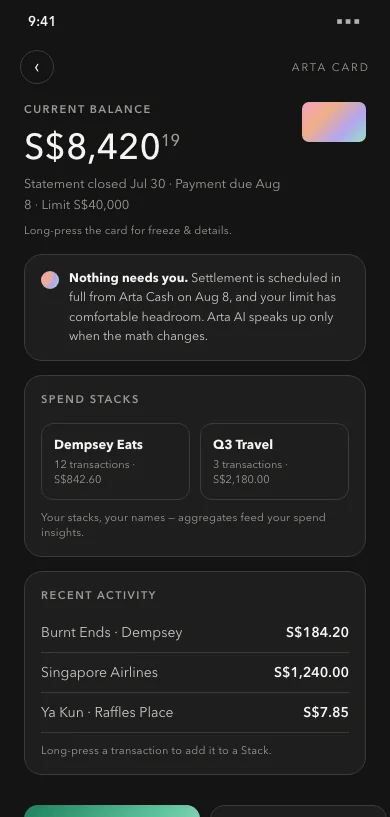
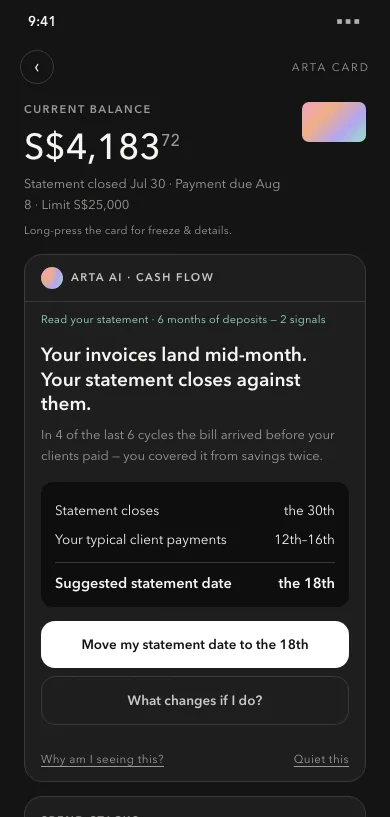
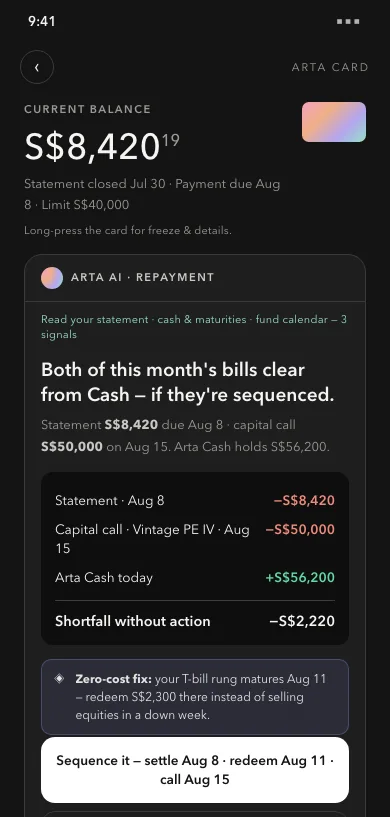
No bolt-on assistant. The AI is contextual intelligence with three postures — quiet → nudge → intervene — and it never decides for the member.
Pre-qualified offer → confirm profile → pledge assets → decision. Four screens carry the whole argument.
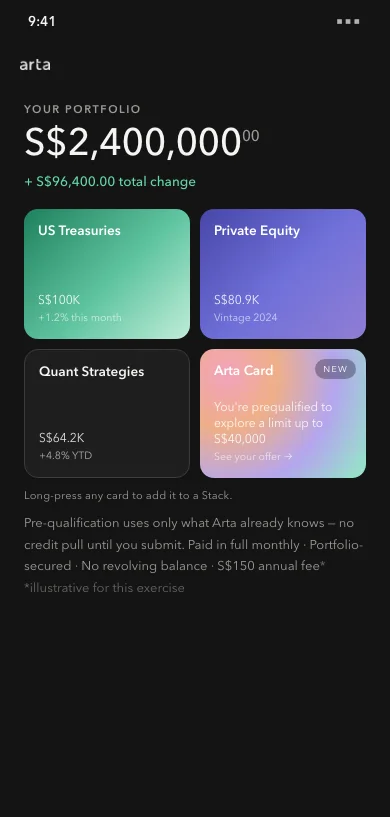
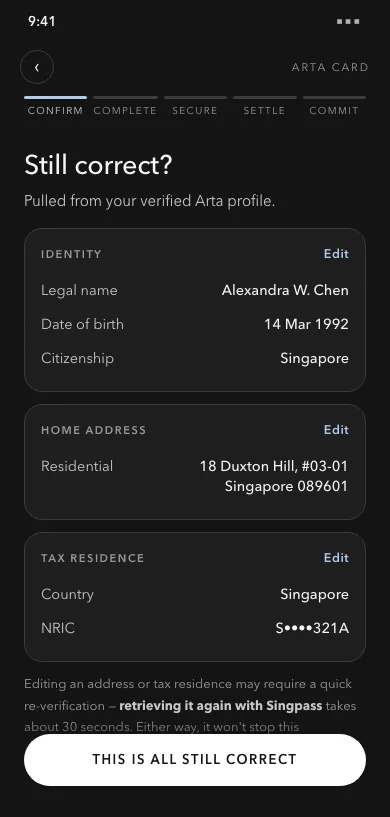
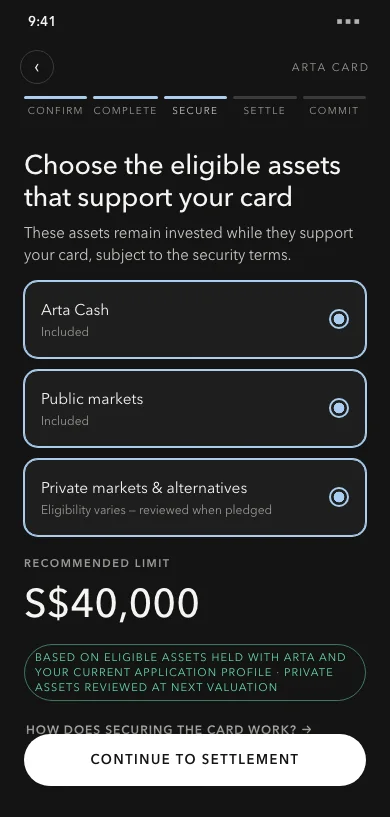
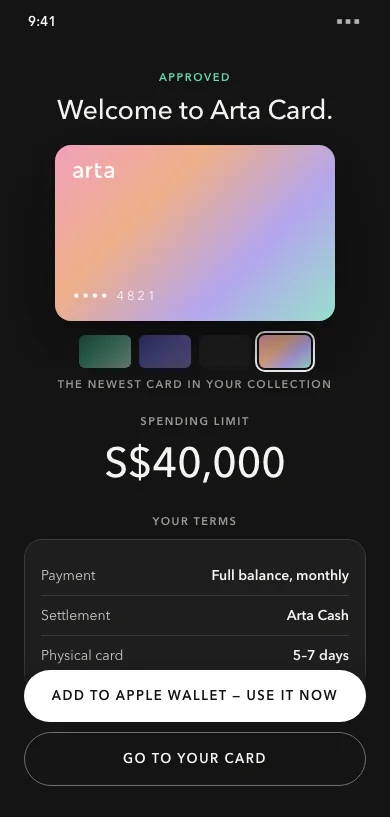
The same card home, three postures. The AI earns attention by mostly staying out of the way.
04 Build with AI
The deliverable isn't a picture of a product — it is the product. Strategy written as specs; specs turned into working fintech software with AI.
Eight markdown specs — framing, both flows, the white-label model, talk tracks — were the source of truth. Claude Code built from them; I directed and refined every screen the way a lead reviews a team's build.
A clickable product tells the truth a static frame can't — real states, real motion, real theming. I don't hand off; I ship. AI doesn't shrink the strategist's role — it extends it to the finish line.
05 Live Product
The prototypes below are running live on this page — tap through them. Or open any surface full-screen.
The problem framing, application flow, AI lifecycle, white-label model, and the trade-offs — with voiceover.
Open presentation → Flow 1 · LivePre-qualified offer → pledge → settlement → decision, walked through for both the core member and the edge case.
Run the flow → Flow 2 · LiveQuiet, nudge, intervene — the card home intelligence, clickable across its three postures.
Run the flow → SystemLive components, tokens, and the Northstar partner demo — the same capability wearing another brand, safely.
Explore the system →06 Reflection
Not "designer with AI curiosity" — product strategist who ships, with the receipts live at a URL.
Not the thinking. What changed is the distance between decision and proof: an idea became a clickable state the same day. Specs replaced handoffs; review replaced production.
Reframing the brief, cutting scope, designing decline as a relationship moment — every judgment call came from experience, not a prompt. AI multiplied the output; the trade-offs are mine.
One designer, one week, one AI pair — and a finished, explorable product that would have taken a small team a sprint. This is the working model I bring to my next team: design judgment at the front, AI-assisted building all the way to the finish line.